In two genres more than any other—blues and folk—the dominant chord B7 does heavy lifting. It drives the turnaround, pushes progressions forward, and supplies just enough grit to make a chorus land. Yet many players avoid it because it buzzes on guitar or sounds muddy on piano. Here’s a practical, musician-first guide to make B7 clean, confident, and musical.
What B7 Actually Is (and Why It Matters)
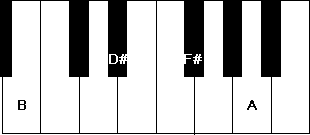
B7 is a dominant seventh built on B: the notes are B–D#–F#–A. Functionally, it wants to resolve to E (V → I in E major or E mixolydian contexts). The tritone between D# and A creates tension; resolve that tritone and the harmony breathes. In a 12-bar blues in E, B7 often appears in bars 9–10 and in the final turnaround. In folk progressions, it’s a frequent pivot to E or to Em (for example, as V/iii in G major).
Guitar: Shapes, Transitions, and Grip Economy
Most players learn the open-position B7 early but struggle to make it ring. Start with the classic voicing and then add alternatives for context and comfort.
| Position | Frets/Strings | Fingering | Tip |
|---|---|---|---|
| Open B7 (x21202) | 5th string (2), 4th (1), 3rd (2), 1st (2) | Index on D string 1st fret; middle on A string 2nd; ring on G 2nd; pinky on high E 2nd | Lightly touch low E with the middle finger to mute it; let open B ring |
| Barre at 7th | Root on low E (7th), typical A7 shape moved up | Barre index on 7th; shape the rest like A7 | Great for tight band mixes; compress with palm near bridge |
| Four-string “grip” | D#–A–B–F# across top four strings | Mini-barre on top strings, omit bass | Use for funk stabs or quick turnarounds |
Clean Changes
- B7 → E: Keep the index planted. From open B7, release ring and pinky, swing the middle to the 2nd fret of D for E. Minimal movement, maximal payoff.
- B7 → Em: Lift the middle and ring, land Em with index/middle; note how the D# (on B7) resolves down to D in Em for a moody color.
- From Bm to B7: Raise the D to D#. This mental model (one note changes) speeds chord-switching across songs.
Strumming tip: Accentuate the top three strings on beats 2 and 4 with a slight down-up flick. The open B string adds shimmer; let it sing instead of pounding the low strings.
Piano: Voicings that Avoid the Mud
On piano, the trouble with B7 is bass heaviness. Keep the left hand simple and the right hand efficient.
- Shell voicing: Left hand plays B (root) and A (7th); right hand plays D# and F#. This 7–3 combo defines the chord clearly.
- Add color: Replace the root in the right hand with C# for a B9 sound; keep the left hand light.
- Drop-2 trick: In the right hand, stack A–D#–F#–B and drop the second note from the top (F#) down an octave. Smooth, open, and band-friendly.
Voice-Leading to E
Resolve D# → E, and A → G# for E major; or A → G and D# → D for E minor. Play these pairs legato while the other notes move minimally. Your ears will recognize the “pull” instantly.
Rhythm First: Make It Groove
- Blues shuffle (guitar): Palm-mute lightly, emphasize the swing (triplet feel). Alternate between the chord and a quick B7sus4 hammer-on (add E on the 2nd string, resolve to D#).
- Ballad comp (piano): Left hand plays root on beat 1 and 5th on beat 3; right hand arpeggiates 7–9–3–5. Keep pedal shallow to avoid blur.
- Bossa touch (both): Straight 8ths, light accents on beats 2 and 4. Use B7(b9) for extra color in intros.
A 10-Minute Daily Plan (One Week)
- Minute 1–2: Slow voicing map. Guitar: hold open B7 and arpeggiate; Piano: shells and 9ths, two bars each.
- Minute 3–4: Transitions. Alternate B7 ↔ E, four beats each, 60–70 BPM. Focus on economy of motion.
- Minute 5–6: Rhythm loop. Pick one feel (shuffle, straight 8ths, bossa). Keep it at a tempo you can lock steadily.
- Minute 7–8: Color tones. Add b9 (C#) or 13 (G#) on top, then resolve to E chord tones; listen for tension–release.
- Minute 9: Micro-turnaround. Try E7 | A7 | E7 | B7, then resolve back to E. Keep everything sub-80 BPM.
- Minute 10: Record one take. Even a phone memo works; review tomorrow for noise, buzz, or muddy notes.
Troubleshooting: Why It Sounds Off (and Fixes)
- Guitar buzz on the high E: Your pinky may be collapsing. Rotate the wrist slightly toward the headstock so the fingertip lands more vertically.
- Unwanted low-E rumble: Use the middle finger’s pad to mute the 6th string while fretting the 5th string note. Check by strumming and tapping the 6th string individually.
- Piano mud: If your left hand is below A2 with full triads, that’s the culprit. Use shells or single-note bass in that register, and move fuller voicings above middle C.
- Rushed resolutions: Practice D#→E and A→G#/G as a two-note exercise with a metronome. Nail the motion; then add the rest of the chord.
- Stiff rhythm: Count out loud. For swing, think “tri-pl-et tri-pl-et”; for straight, subdivide “and”s quietly under your breath.
Put It to Work: Mini Progressions
Try these in a slow loop; aim for even tone rather than speed.
- Blues in E (bars 9–12): B7 | A7 | E7 | B7. Add a b9 on the last bar for a tasty turnaround.
- Folk flavor: G | D | Em | B7 → Em. Use a soft arpeggio; let B7’s D# slide to Em’s D.
- Jazzier cadence: F#m7 | B7(b9) | Emaj7 | E6. Keep the left hand light and the right-hand tensions controlled.
Key Takeaway
B7 isn’t a hurdle; it’s a hinge. Clean voicings, disciplined voice-leading, and steady rhythm will turn it from a clunky chord into the moment the song leans forward. Spend ten focused minutes a day on transitions and tone, and within a week you’ll hear it: the chord clicks, the resolution lands, and the groove holds.